For the week ending May 6, Federal Reserve custody data showed something unusual. Foreign official holdings of U.S. Treasuries fell by $8.7 billion to $2.73 trillion — the first decline in a month. The timing was not random.
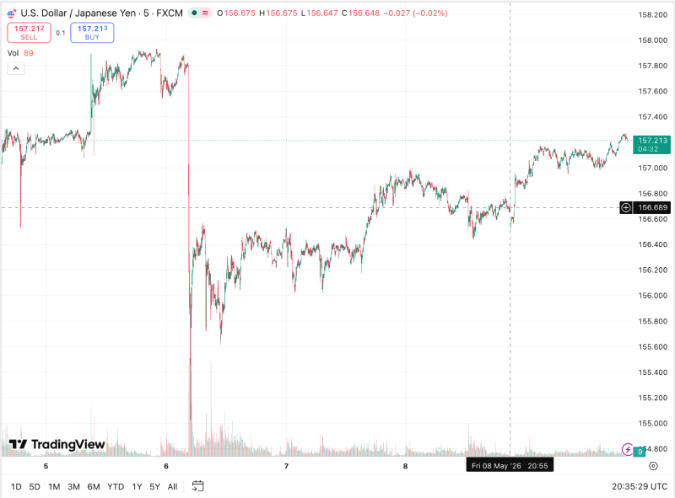
That same week, Japan's Ministry of Finance was suspected of spending approximately $54.7 billion to buy yen and push USD/JPY back from the 160 level. The yen surged from 160+ to 151 in hours before settling around 155–156.
The $8.7 billion drop in Fed custody data may significantly understate the actual Treasury market impact. Shusuke Yamada, Bank of America's Tokyo-based strategist, noted that historically, the cash portion of Japan's foreign exchange reserves does not decline much during intervention episodes. If this pattern holds, the securities portion — read: U.S. Treasuries — likely absorbed supply pressure closer to $70 billion.
This is the mechanics of unsterilized intervention: yen is bought, dollars are sold, Treasuries are liquidated, and the cash does not return to the market.
The Treasury market faces two active supply pressures. First, U.S. Treasury issuance to fund the fiscal deficit — running at roughly $63 billion per month net in Q2, with Q3 borrowing needs revised up to $671 billion. Second, Japan's suspected intervention liquidation — roughly $35 billion spent in early May, with an estimated ~$70 billion market impact if Yamada's reserve-composition logic holds.
Some market commentary has framed this as three concurrent sellers, counting the Federal Reserve's balance sheet reduction, so-called quantitative tightening, or QT. That program ended on December 1, 2025. The Fed is no longer shrinking its holdings. In fact, it is now buying roughly $25 billion in short-term Treasury bills monthly through Reserve Management Purchases to keep bank reserves stable — a demand support, not a supply pressure.
Rodrigo Catril, senior FX strategist at National Australia Bank: "The movement in the account seems to correlate, coincide with the MOF instructing the Bank of Japan to intervene... If this becomes a regular theme, then it could become an issue for the U.S. Treasury market."
USD/JPY at 160 is where import inflation becomes politically toxic in Japan. Energy, food, and raw materials spike in cost. The BOJ's 0.75% policy rate looks increasingly untenable against the Fed's 3.50–3.75%.
But intervention alone does not fix the divergence.
Jesper Koll of Monex Group described it precisely: "Intervention without changing domestic monetary policy is like tapping the brake while keeping your right foot firmly on the accelerator — at best, your passengers have a little fun, at worst, you're burning through your brake pads."
Japan intervened twice in early May — April 30 and May 6 — spending an estimated $35 billion through the Golden Week holiday alone. The yen bounced, then faded. The carry trade — borrowing cheap yen to fund higher-yielding assets elsewhere — remains roughly 50% above early 2021 levels. Fundamental compression has not occurred.
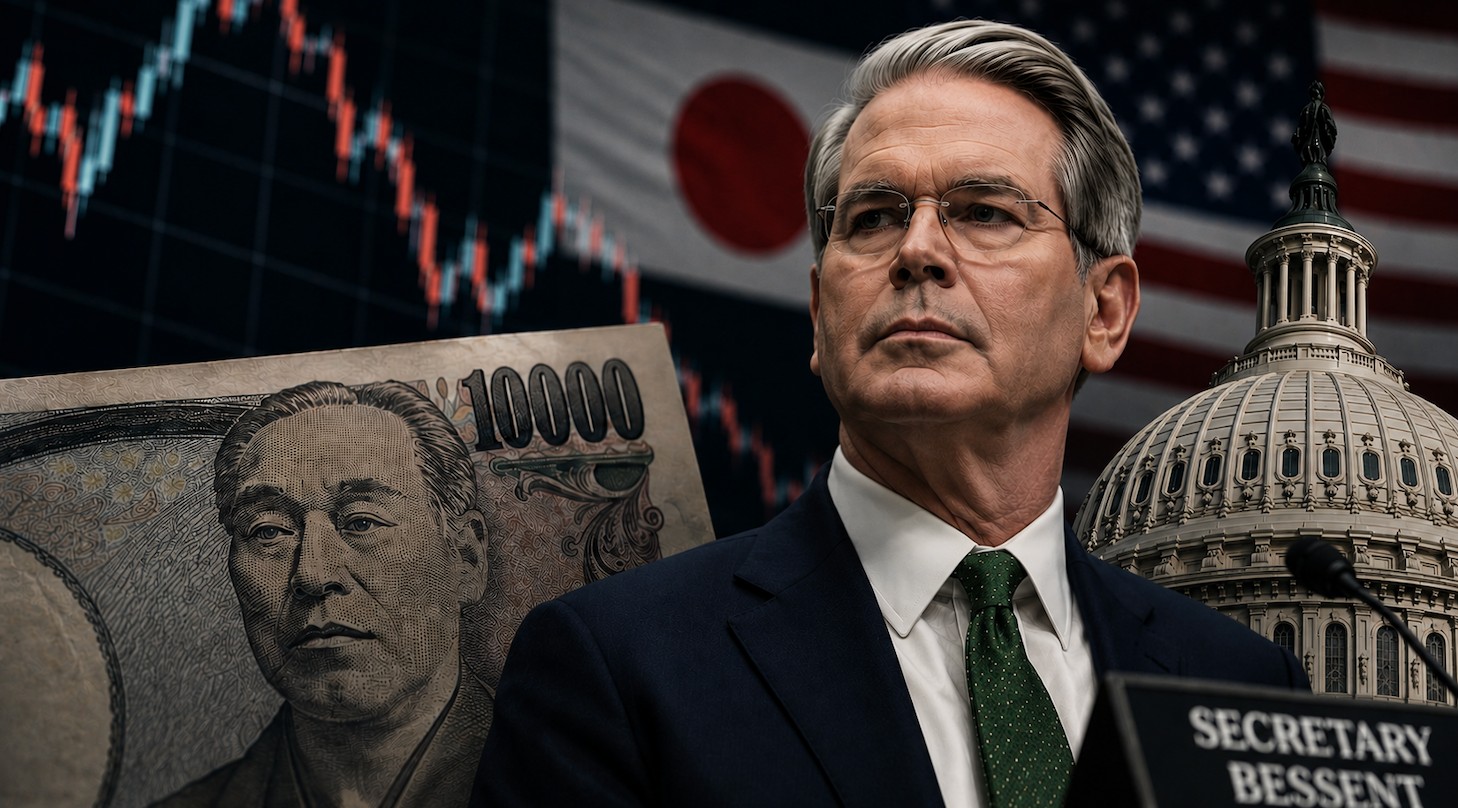
US Treasury Secretary Scott Bessent lands in Tokyo May 12 with two flashpoints in his brief.
First, the intervention bill. Japan spent ~$35 billion defending 160 during thin-liquidity Golden Week. Markets suspect those dollars came from Treasury sales — unsterilized, permanent supply hitting a market already absorbing heavy US issuance. Bessent needs to know: was this one-off, or is Tokyo establishing a standing facility?
Second, the rate dilemma. The BOJ debated hiking to 1.0% in April, with three dissents. Faster tightening supports yen organically, reducing intervention needs. But a stronger yen = weaker dollar, and this administration likes dollar strength. Bessent's messaging will reveal which lever Washington prefers: BOJ hikes (less Treasury selling) or MOF intervention (more).
The market read is binary. Coordination signal → yen stabilizes, shorts cover, confidence returns. Friction or pressure to temper hikes → 160 retests, MOF burns more reserves, Treasury supply questions deepen.
Japan's suspected Treasury liquidation is a supply shock in the world's benchmark bond market, triggered by a currency defense that cannot succeed without either Fed cooperation or BOJ hawkishness.
The $70 billion is not a one-time event. It is a recurring liability if 160 breaks again and MOF responds the same way.
Bessent's Tokyo visit is the first attempt to manage this tension. The signal he sends — coordination or friction — determines whether this stays a contained bilateral issue or becomes a structural Treasury market stress episode.
For yen levels, for U.S. yields, and for capital flows into Japanese assets, that signal is the only thing that matters right now.
Sources
-min.jpg)