On 24 July 2026, China’s Ministry of Finance and State Taxation Administration issued Announcement No. 21, accompanied by State Taxation Administration Announcement No. 15. Together, they establish China’s first comprehensive individual income tax framework specifically addressing trusts and trust-like arrangements created under foreign law.
The two announcements serve different but complementary purposes.
Announcement No. 21 establishes the core tax treatment of offshore trusts. It sets out how Chinese individual income tax can apply when assets are transferred into an offshore trust, when income arises within the structure, when benefits are distributed to beneficiaries, and when certain termination, migration or succession events occur.
Announcement No. 15 provides the administrative framework supporting those rules, including reporting procedures, filing requirements and documentation obligations. Together, the measures create a compliance mechanism covering the lifecycle of an offshore trust, from initial funding and ongoing income to distributions and eventual termination.
The framework applies nationwide, but it should not be described as a general tax on every overseas account or asset. Its application depends on factors including Chinese tax residence, who contributed or controls the assets, the source of those assets and whether a Chinese-resident beneficiary receives income or economic benefits.
For Chinese resident individuals, transferring appreciated assets into an offshore trust can be treated as a taxable property transfer. The taxable amount is generally the asset’s market value at transfer minus its original cost and reasonable expenses, rather than 20% of the asset’s gross value. Income subsequently earned by a resident-funded trust and certain controlled offshore entities may also be attributed to the resident contributor even if it remains offshore rather than being distributed.
The rules also address non-resident contributors. China-sourced assets transferred by a non-resident may be taxable, while distributions from a non-resident-funded trust to a Chinese resident can be taxed in the resident beneficiary’s hands. Loans, guarantees, expenses paid for residents and below-market use of trust property may also be treated as deemed distributions in specified circumstances.
The 22 October 2026 date is genuine, but its scope is limited.
Announcement No. 21 provides a 90-day transitional period from 24 July for taxpayers to declare and pay specified historical liabilities without late-payment surcharges. This includes certain historical trust contributions and income falling within the scope of the new framework.
The tax itself is not waived.
After the window closes, overdue surcharges may apply and more serious non-compliance can attract penalties under China’s tax administration regime.
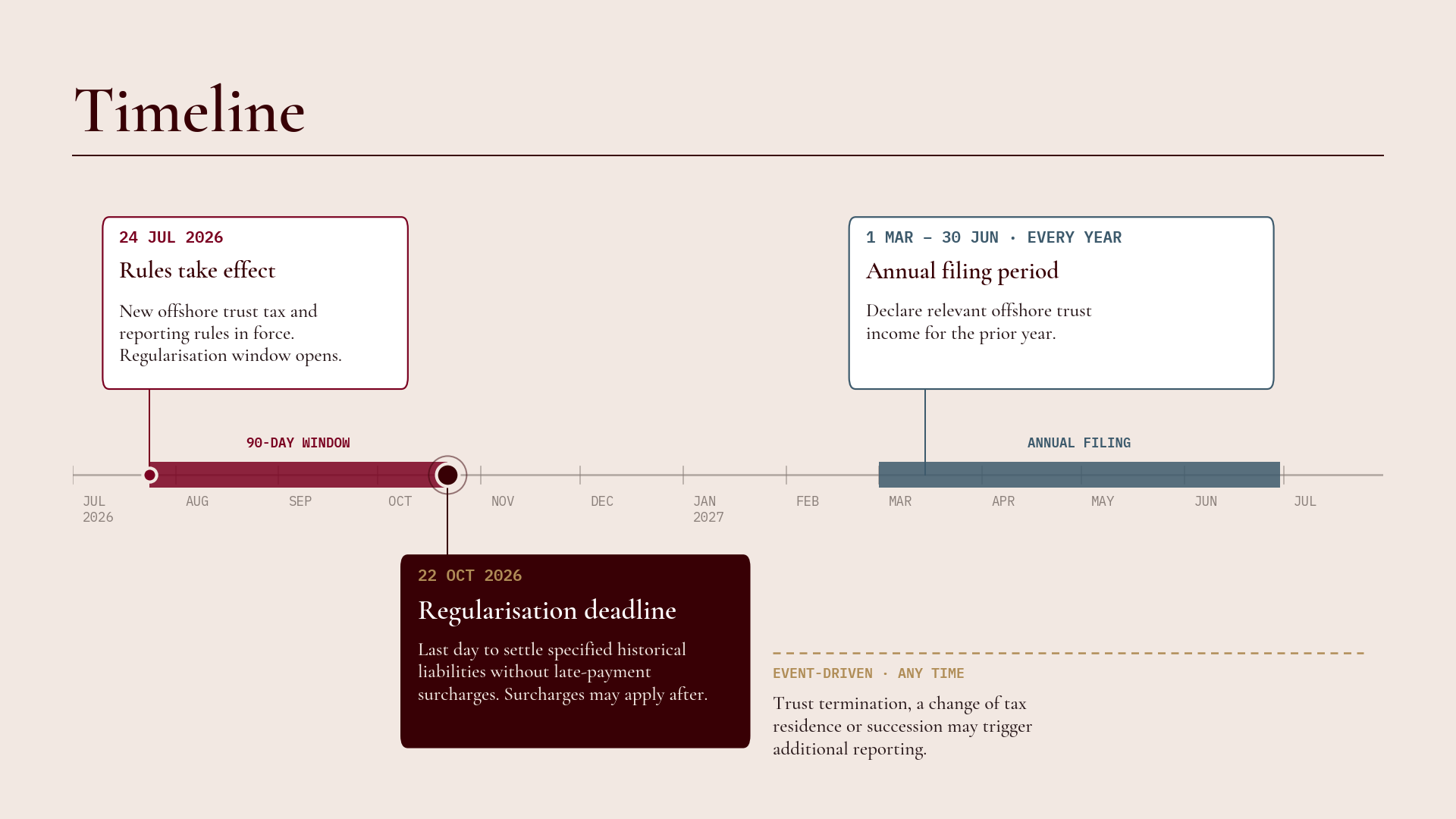
The deadline should therefore not be interpreted as a blanket requirement for Chinese residents to declare all offshore wealth by 22 October. Rather, it is a transitional regularisation window within a much broader offshore trust compliance framework.
Beyond the transitional period, the new regime introduces continuing reporting obligations. Resident taxpayers generally report relevant offshore trust income during the annual individual income tax filing period from 1 March to 30 June of the following year. Certain events involving non-residents, trust termination, changes in tax residence or succession can trigger separate reporting requirements.
Initial filings may also require information on the trust structure and historical financial records, increasing the importance of maintaining accurate documentation across the life of the arrangement.
Chinese residents were already subject to tax on worldwide income, and China had already been strengthening scrutiny of offshore earnings. Earlier enforcement cases showed authorities using tax data analysis to identify undeclared overseas income and require supplementary tax and late-payment charges. The OECD’s Common Reporting Standard also enables participating jurisdictions to collect financial-account information and exchange it annually.
What changed in July is the introduction of a dedicated, administrable framework for offshore trusts: clearer attribution rules, defined filing requirements, annual reporting, valuation requirements and specific treatment at contribution, during the trust’s life, on distributions and when residence, termination or succession changes.
The development is therefore part new legislation and part intensified enforcement of the longstanding principle that Chinese residents are taxable on worldwide income.
For settlors, beneficiaries and trustees, the practical effect is greater transparency throughout the structure. Trustees may need to maintain sufficiently detailed accounting and financial records to enable Chinese taxpayers to meet their reporting obligations, while families will need greater visibility over historical transfers, valuations, distributions and accumulated income.

For affected HNWIs, the practical difficulty may be a mismatch between taxable gains and available cash.
A contribution of appreciated private-company shares or property can create tax even though no external sale has generated cash. Annual attribution of undistributed income can create similar pressure. Families, trustees and private banks are therefore likely to focus increasingly on valuations, historical records, potential liabilities and how those liabilities will be funded.
That does not prove that any particular asset sale or financing transaction is tax-driven. Nevertheless, it is reasonable to expect some affected families to consider selling liquid securities, borrowing against assets, postponing further trust contributions or rebalancing portfolios. Others may retain their structures but improve accounting, reporting and liquidity reserves.
The likely result is selective repositioning rather than a uniform withdrawal from offshore investment.
Tax-related liquidity requirements may already be creating selective buying opportunities in Japanese real estate. As affected China and Hong Kong-linked owners reassess their offshore holdings ahead of upcoming trust tax deadlines, some may seek accelerated sales to raise liquidity, potentially creating opportunities for buyers able to move quickly. While individual transactions should not automatically be attributed to tax pressure, motivated sellers facing near-term funding requirements could result in assets coming to market at more attractive pricing.
This potential selling pressure comes at a time when Japan’s commercial property market continues to show strong investment activity and rental growth. CBRE recorded ¥1.121 trillion of commercial property investment in Q2 2026, up 17% year on year, reflecting continued investor activity. Leasing fundamentals were also strong. In Tokyo’s five central wards, Savills reported Grade A office rents rising 17.1% year on year in Q2 2026, while large-scale Grade B rents increased 17.7%.
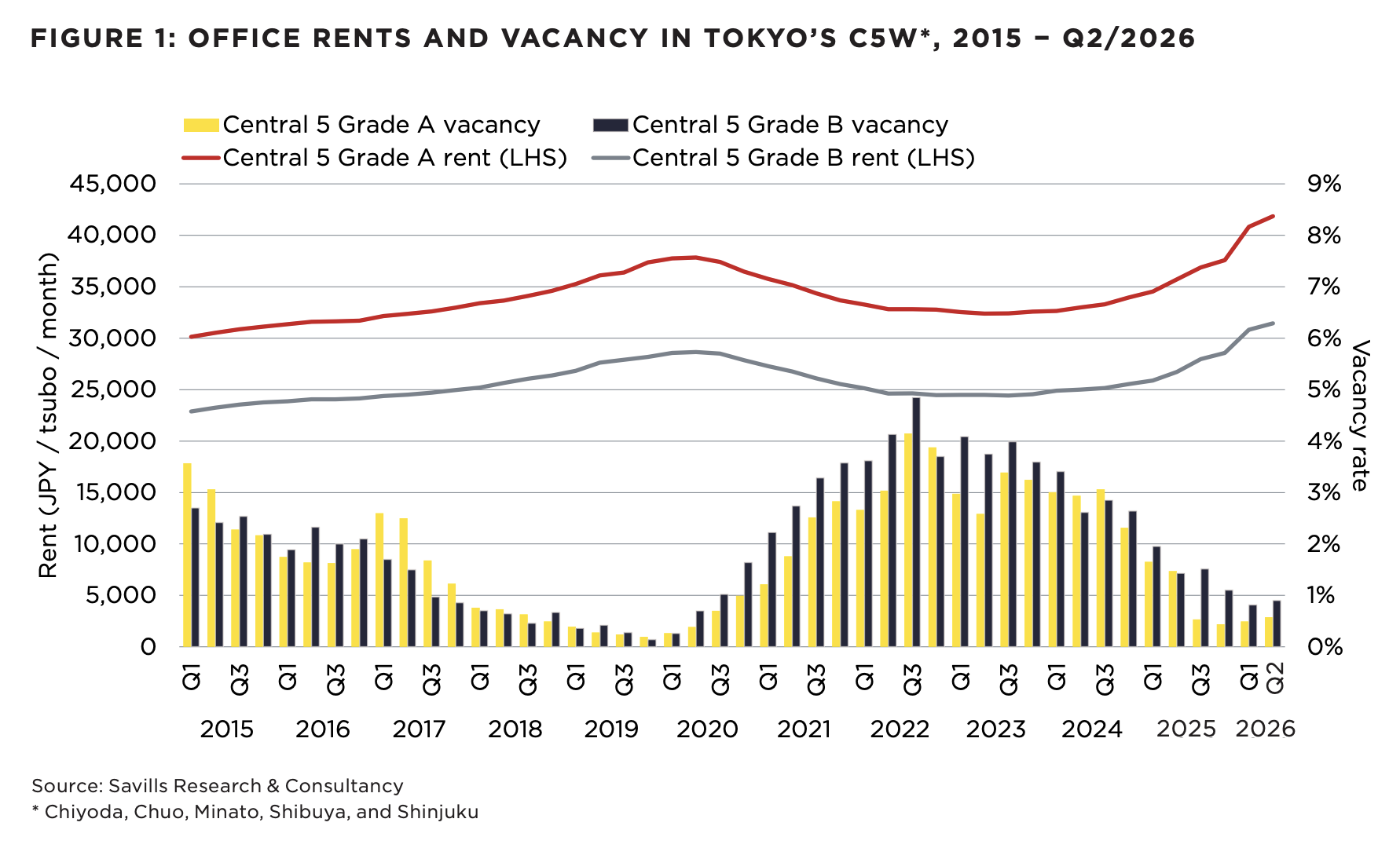
For family offices and long-term investors, this creates a potentially attractive combination: selective acquisition opportunities arising from seller liquidity needs, alongside a commercial property market supported by strong investment activity and rental growth. However, there is not yet sufficient public evidence to suggest a broad tax-driven distressed-sale cycle, making asset selection and pricing discipline particularly important.
-min.jpg)